To celebrate World Photography Day, the Congo Basin Science Initiative (CBSI), together with its French partner initiative One Forest Vision (OFVi), invited their researchers to showcase their work through a photograph that captures an aspect of their research. The competition aimed to highlight both the scientific importance of their work and the unique field experiences behind it.
From the submissions received, CBSI and OFVi selected six photographs that give a snapshot of the diversity of research being conducted across the Congo Basin. These six images were then shared with their online communities, who were invited to vote for their favourites. Through this public vote, the initiative offered a unique opportunity to connect science, storytelling, and photography, while giving wider visibility to the researchers and their work.
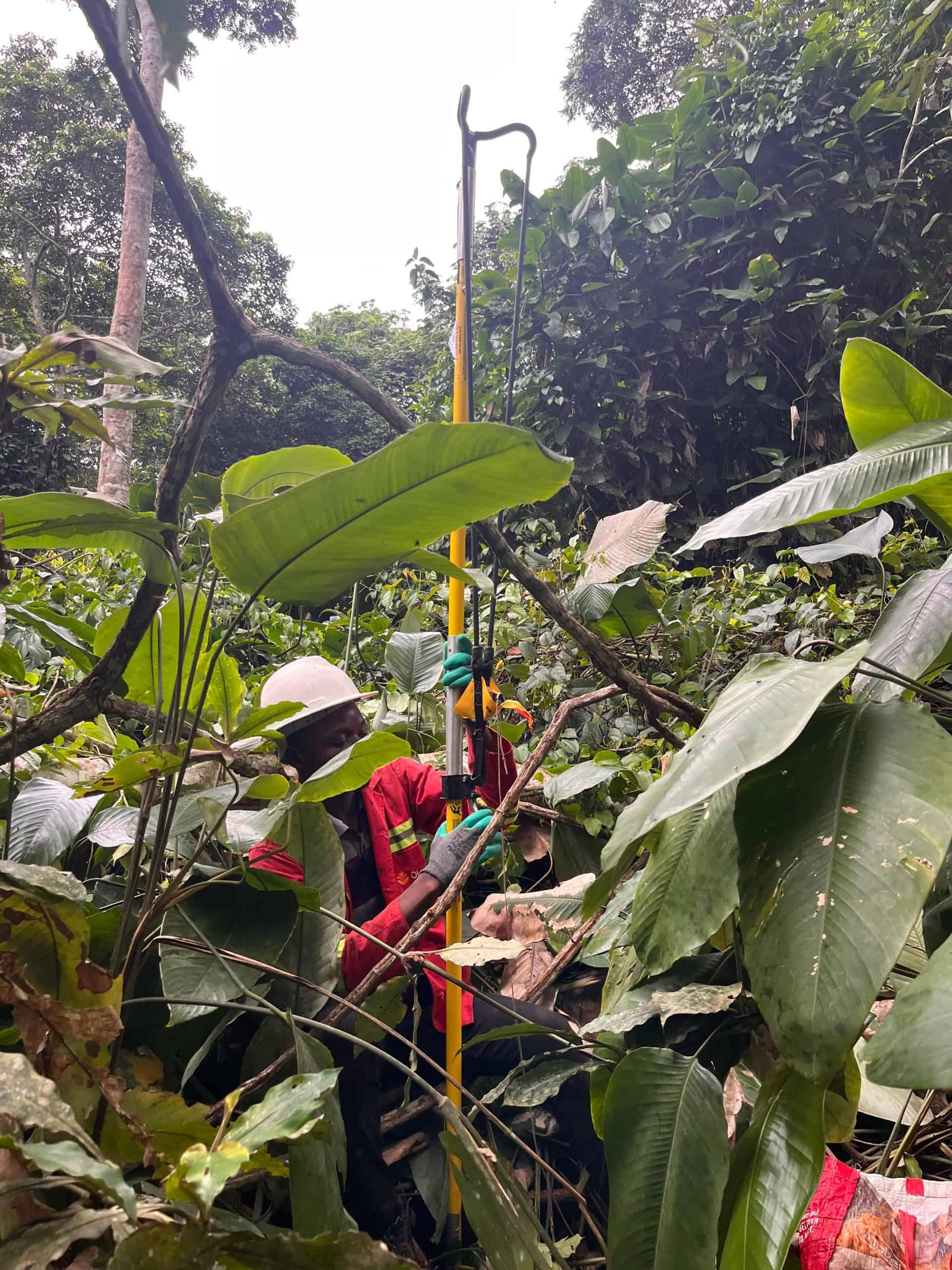
With 300 votes out of 526, CBSI student Styven Mahoungou, one of 31 scholars of the CRAFT project funded by UK International Development, was awarded first place. Styven is a PhD student at the Marien Ngouabi University in Congo-Brazzaville and his project is entitled: Measuring and mapping the ecological restoration of tropical forests: Towards an integrated framework for assessing ecosystem recovery in the Congo Basin. His photo “Observe, measure, understand : three actions at the heart of field research” shows Styven during his fieldwork in Odzala-Kokoua National Park, Republic of the Congo, as part of his PhD research on the regeneration dynamics of secondary forests. The aim is to better understand how forest communities regrow after disturbance, particularly by tracking changes in their functional characteristics through ecological succession. In the photo, Styven is collecting leaves from the canopy using a Notch Big Shot. Styven and his group selected the most abundant species within their study plots and sampled mature leaves from different positions in the canopy. These samples were then used to measure a range of functional traits, including spectral reflectance, leaf area, thickness, water content, and carbon and nitrogen concentrations.
For me, this photo perfectly represents the intersection of fieldwork and science: a very simple action, reaching a leaf in the canopy, that ultimately allows us to ask broader questions about the functioning and recovery trajectories of forests in the Congo Basin.
The scientific idea behind this work is that leaves act as a true interface between a tree and its environment. Their traits provide information about growth strategies, resource acquisition, and resource conservation, and can therefore change during forest succession. Styven seeks to understand how the gradual replacement of fast-growing pioneer species by more shade-tolerant species is accompanied by shifts in the forest’s functional strategies. This perspective is central to understanding the recovery trajectories of tropical forests.
What I particularly enjoy about this approach is the change in scale it enables: from a single leaf sample collected several metres above the ground, to canopy characterization, and ultimately to satellite-based observation of the landscape.
Field measurements are used to model canopy reflectance and establish links with Sentinel-2 data, with the goal of monitoring forest regeneration over much larger spatial scales.
With 100 votes, CBSI student Roger Mpolo Itoto, a PhD CRAFT scholar, was awarded second place.
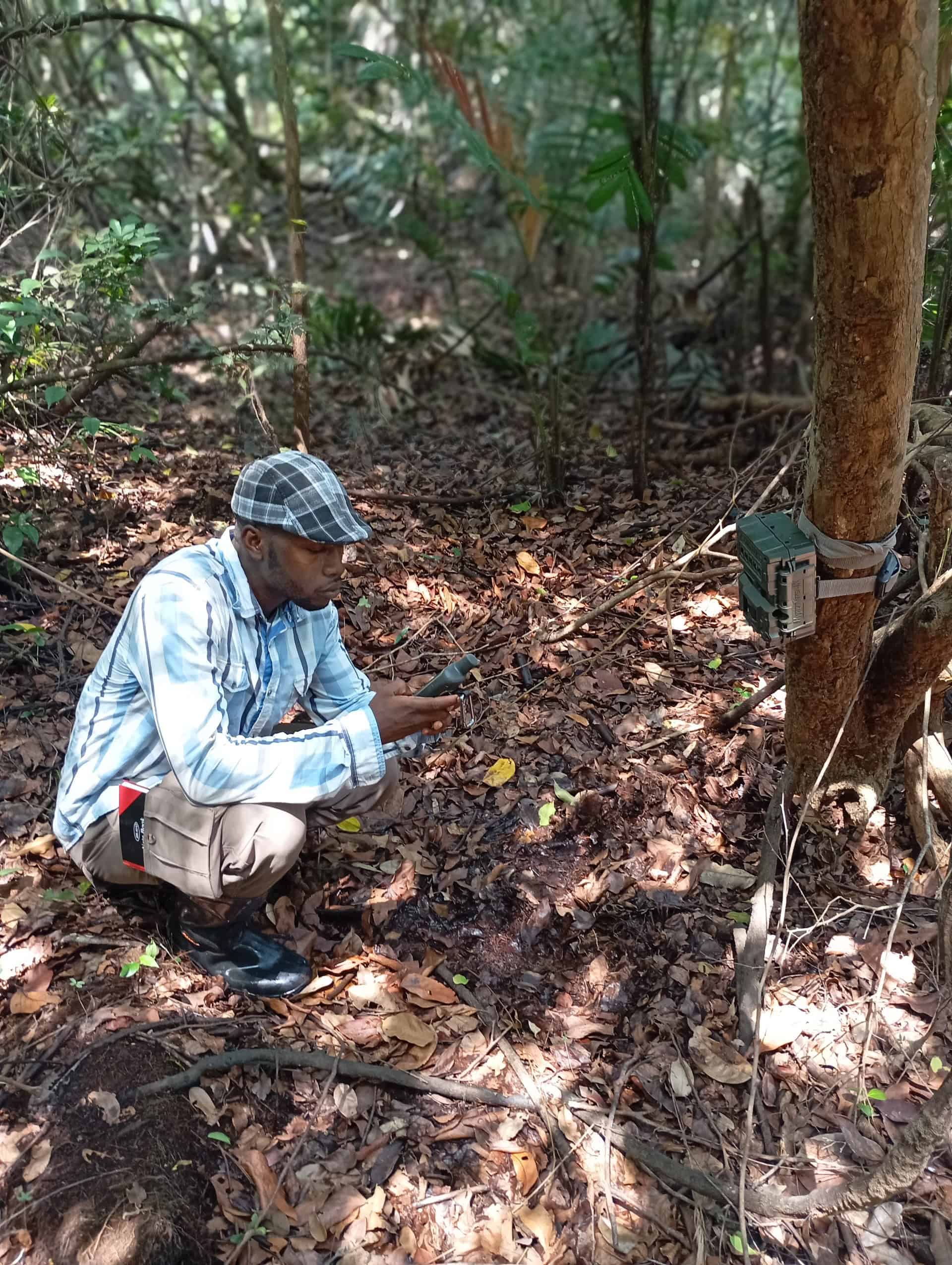
This photo was taken during his very first field mission in the Mabali Scientific Reserve, Democratic Republic of the Congo, as part of his PhD project entitled: “Effects of Different Land Uses on Mammal Distribution in the Mabali Scientific Reserve Area, Democratic Republic of the Congo.”
For me, this mission marked the true beginning of a scientific fieldwork adventure on an entirely new scale.
Roger’s objective was to establish the sampling design that would serve as the foundation for his and his team’s research. Using QGIS, they generated a systematic grid along with a series of randomly selected theoretical sampling points. The next step was to go into the field, navigate through the forest, and deploy camera traps at each of these predefined locations.
“In the field, reality is very different from what appears on a computer screen. Walking for hours through the forest, forging a path forward, navigating, and accurately locating sampling points require a great deal of patience, endurance, and determination. Yet every step also provides a unique opportunity to learn and to gain a deeper understanding of this remarkable environment”.
The study encompasses different land-use types, including the Mabali Scientific Reserve, community forests, and logging concessions. The goal is to understand the factors that influence the distribution of large mammals and, more broadly, to contribute to a better understanding and conservation of biodiversity in the Congo Basin.
For me, this photo symbolises far more than a simple fieldwork moment. It represents the beginning of a research journey, an immersion into the heart of the forest, and a commitment to better understanding and helping to preserve our biodiversity.
We congratulate Styven and Roger for their exceptional work and express our gratitude to all participants who contributed photos and voted during the contest.
Gallery of the other four contest photos:
Third place with 45 votes: